Queer Places:
225 W 44th St, New York, NY 10036, USA
909 7th Ave, New York, NY 10019, USA
Maple Grove Cemetery, 127-15 Kew Gardens Rd, Kew Gardens, NY 11415, United States
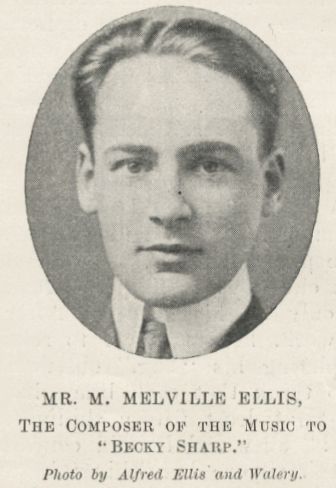 Melville Ellis (November 1876 - April 4, 1917) was a multifaceted artist of early American theater, vaudeville, and silent cinema whose diverse talents
spanned piano performance, musical composition, acting, choreography, and costume and scenic design.
Melville Ellis (November 1876 - April 4, 1917) was a multifaceted artist of early American theater, vaudeville, and silent cinema whose diverse talents
spanned piano performance, musical composition, acting, choreography, and costume and scenic design.
Born in Phoenix, Arizona, in November 1876 (or late 1870s depending on historical source records), Ellis moved early in life to San Francisco,
California, where his mother Rachael Mendelson and brother resided. While in San Francisco, he took a job as a clerk in a music store, immersed himself
in popular sheet music, and developed into an accomplished pianist.
Seeking broader horizons, Ellis relocated to New York City and quickly established a prominent presence on Broadway—then known as the "Great White
Way." He gained immense popularity in vaudeville for his signature "pianologues," a performance style blending comic monologues with live piano
accompaniment. His musical talents eventually reached the film industry, where he became a pioneer of "music off-stage," bringing his piano directly onto
movie sets to play mood music that helped silent film actors evoke the precise emotional nuances required for their scenes. Notably, director Cecil B.
DeMille utilized Ellis's off-stage piano accompaniment during the filming of the 1915 silent motion picture Carmen.
Ellis’s creative ambition led him far beyond performance. He became a true theatrical polymath on Broadway, working seamlessly as a composer, singer,
actor, choreographer, and designer of costumes and scenery. His design talent was particularly celebrated in revue productions, including work for the
Ziegfeld Follies and major Shubert theatrical productions. Ellis held strong artistic theories on visual production; in a 1912 interview with The New
York Press, he outlined his concept of color harmony, asserting that visual shades directly correspond to musical tempos and emotions, and advocating for
a dynamic "crescendo effect" in costume presentation so that the eye and ear synchronized for the audience.
Throughout his career, Ellis collaborated with some of the most notable stars and personalities of his era, including Al Jolson, Fanny Brice, Eddie
Foy, and the Dolly Sisters. He maintained a close personal and professional friendship with the pioneering interior designer and actress
Elsie de Wolfe (later Lady Mendl), who designed his office space in 1915.
Alongside his public artistic career, biographical and historical records indicate significant queer connections within Broadway's creative elite.
While theatrical titan Lee Shubert maintained a conventional personal life—later marrying actress Marcella
Swanson secretly in Berlin in July 1936, divorcing in Reno in 1948, and remarried in Miami in 1949—accounts from contemporary theater figures point to
hidden LGBTQ relationships within the empire. Oscar-winning costume and production designer
George James Hopkins, who regarded Ellis as a vital early mentor, noted in historical records and
autobiographical accounts that the dashing Ellis served as a romantic lover to Lee Shubert. These accounts highlight the fluid, often secretive networks
of LGBTQ creatives who shaped the visual and performing arts of early 20th-century Broadway.
In early 1917, after completing a three-week vaudeville run, Ellis returned to New York to headline at the Palace Theatre—the acclaimed "Valhalla of
Vaudeville," marking the peak of a vaudeville performer’s career. Shortly after starting his run at the Palace, he fell gravely ill with typhoid fever,
which was believed to have been contracted from contaminated water during a prior performance stop in New Orleans. His health deteriorated rapidly, and
he passed away at a Manhattan hospital on April 4, 1917, at the age of 40. Following his death, his close friend Elsie de Wolfe handled his final
arrangements and had him buried in her family’s plot at Maple Grove Cemetery in Kew Gardens, Queens, New York.
References:
- George James Hopkins, Caught in the Act (Unpublished Memoir, 1981)
- The New York Press (1912 Interview)
- The New York Clipper (1915–1917 Issues)
- Variety (1900s–1917 Issues)
- Friends of Maple Grove Cemetery Archives (Kew Gardens, Queens, NY)
- "Spirits Alive" Living History Educational Scripts
- Cecil B. DeMille Production Documentation (1915)
- Shubert Organization & Ziegfeld Follies Production Records
Support this project
This website is a passion project researched, developed, and funded entirely by me. If you find the content valuable and would like to help support the ongoing research and hosting costs, any contribution is deeply appreciated.
Thank you for keeping this independent resource alive!
My books on Amazon: Elisa Rolle's books
BACK TO HOME PAGE